
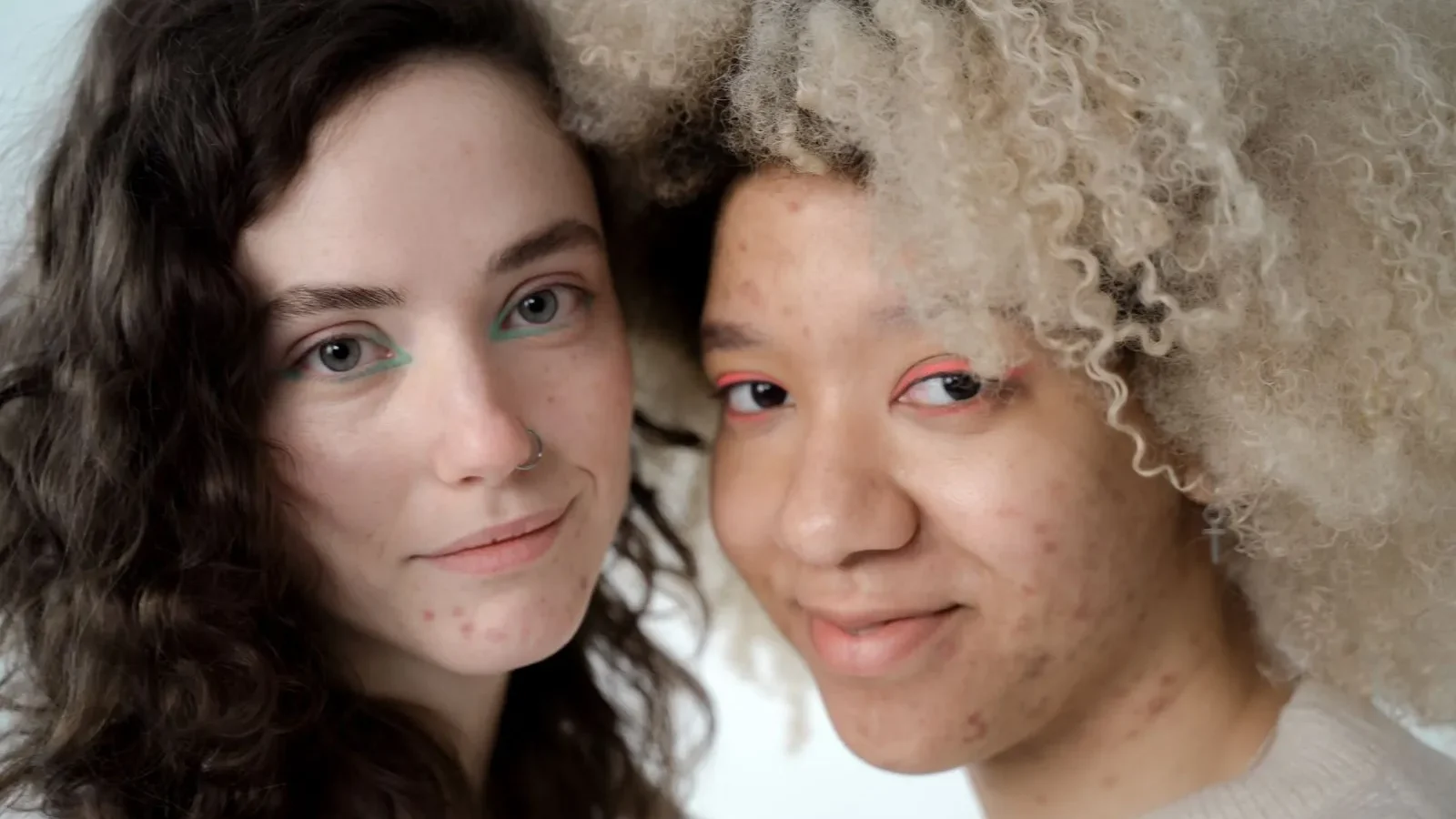
If your breakouts sit mostly along the jawline and chin and get worse before your period, hormones are a likely driver, especially if your skincare routine hasn’t made much difference. The clogged-pore explanation behind most acne only covers part of the story here. That changes how hormonal acne treatment should work, because clearing this kind of acne usually means looking at what’s happening underneath the skin as well as on it. For some women, that includes a conversation about PCOS.
What makes hormonal acne look different
Hormonal acne has a fairly recognizable pattern. It tends to sit on the lower face, along the jawline, chin and sometimes the neck, instead of spreading across the forehead and nose the way teenage acne often does. The lesions are usually deeper too: tender, cystic bumps that sit under the skin, unlike the blackheads and whiteheads covered in our guide to different types of acne.
Timing is the other giveaway. Between 60 and 70% of adult women with acne notice it gets worse in the days before their period, according to a clinical practice guide on adult female acne. In that phase of the cycle, hormones with stronger androgen-like effects rise relative to estrogen, and the skin’s oil glands respond. If your skin follows a monthly pattern like clockwork, the trigger is probably hormonal and has little to do with your cleanser.
The PCOS connection
Polycystic ovary syndrome is one of the most common reasons hormonal acne shows up and sticks around. PCOS involves raised androgen levels and, often, insulin resistance. Both push the oil glands into overdrive, so breakouts become more frequent and harder to shift than ordinary acne.
Acne is one of the most frequent skin signs of the condition. A 2025 meta-analysis of 95 studies found acne in about half (49%) of women with PCOS, with rates varying widely between regions. A cross-sectional study at a tertiary care center found acne in 40.6% of PCOS patients, alongside excess hair growth in 47.3% and scalp hair thinning in 20.3%. If jawline acne has been a long-running, stubborn pattern for you, PCOS is a reasonable thing to raise with a doctor.
Other signs worth mentioning to your doctor
Acne on its own doesn’t confirm PCOS. It’s one piece of a larger picture, and only a doctor can put that picture together. If jawline acne shows up alongside any of the following, raise all of it in the same appointment so each symptom isn’t treated in isolation.
Irregular or unpredictable periods, unwanted hair on the face or body, thinning hair on the scalp, and weight changes that are hard to explain are the symptoms most often seen together with PCOS-related acne. None of these alone means you have PCOS, but a gynecologist or endocrinologist is trained to evaluate exactly this kind of combination.
Hormonal acne treatment: treating the skin and the cause
Skincare and topical products can calm hormonal acne somewhat, but they don’t fix the hormonal imbalance behind it. When PCOS or another hormonal cause is confirmed, treatment usually works on two fronts at once. Doing only one tends to leave the other side undoing your progress.
Medical treatment for the hormonal side
For acne driven by hormones, doctors commonly consider combined oral contraceptives or spironolactone. A review of hormone-based therapies describes both as effective options for adult acne in women, and lists jawline distribution and menstrual flares among the signs that point toward hormonal treatment. These medicines need a prescription and a proper medical assessment first, so this part of the plan sits with your gynecologist, endocrinologist or dermatologist. They are long-term treatments, and the skin improves gradually.
Clinic treatments for the skin side
While the hormonal side is being managed, in-clinic treatments can help with active breakouts and the marks they leave behind. A chemical peel can help clear congested pores and fade the dark marks that hormonal breakouts often leave on brown skin. A HydraFacial deep-cleanses and hydrates, which many people with oily, congested skin find useful between other treatments.
Scarring is usually treated once breakouts are under control, since new acne can keep damaging skin that’s being repaired. At that stage, Face PRP or RF microneedling can work on texture and any scars that remain. These treatments support medical care for PCOS and work best alongside it.
Frequently asked questions
What is the best hormonal acne treatment?
It depends on what’s driving the acne. When hormones are the cause, the most reliable results usually come from combining medical treatment for the hormonal side, prescribed by a doctor, with skin treatments for breakouts and marks. A consultation helps work out which combination suits your skin.
Does jawline acne always mean I have PCOS?
No. Jawline acne is common on its own and doesn’t automatically mean PCOS. It’s worth mentioning to a doctor, especially if you have other symptoms, but it isn’t a diagnosis by itself.
Can hormonal acne be treated with skincare alone?
Skincare can help manage symptoms. If a hormonal imbalance is driving the acne, though, it usually won’t fully settle until that cause is addressed medically.
Why does my acne flare before my period every month?
This is one of the most common signs of hormonally driven acne. Hormone shifts in the days before menstruation increase oil production, which triggers breakouts in a fairly predictable pattern.
Will treating PCOS clear up my acne?
It often helps significantly, though many people still benefit from skin treatments for existing marks and scarring alongside their hormonal treatment.
Who should I see first, a dermatologist or a gynecologist?
Either is a reasonable starting point. What matters is that both the skin and the underlying hormonal picture get looked at, since treating only one rarely resolves the full pattern.
Get your breakouts assessed at BioFlex
A consultation can help work out whether your acne pattern points to a hormonal cause and which skin treatments make sense for you. Our team will also tell you when it’s worth seeing a gynecologist or endocrinologist first. BioFlex Aesthetics has clinics in Islamabad (F-8), Islamabad (Golra Mor), Rawalpindi (Bahria Town), Karachi and Peshawar.
Clinical sourcing
- Acne prevalence among women with PCOS by ethnicity (about half of South Asian women with PCOS vs roughly 22% of white women with PCOS), from a systematic review and meta-analysis on acne vulgaris prevalence among women with PCOS. Ramezani Tehrani F, et al. Gynecological Endocrinology, 2020. https://doi.org/10.1080/09513590.2020.1859474 (Verify the ethnic subgroup figures in the full text before publishing.)
- Global pooled prevalence of acne in women with PCOS (49% across 95 studies), from a 2025 systematic review and meta-analysis. Med J Islam Repub Iran, 2025. https://pubmed.ncbi.nlm.nih.gov/41089626/
- Cutaneous manifestations of PCOS (acne in 40.6% of cases, alongside hirsutism in 47.3% and androgenic alopecia in 20.3%), from a cross-sectional study at a tertiary care center. Cureus, 2022. https://pmc.ncbi.nlm.nih.gov/articles/PMC8777386/
- Premenstrual acne flare pattern (worsening before the period in 60–70% of adult women with acne), from a clinical practice guide on adult female acne. Anais Brasileiros de Dermatologia. https://pmc.ncbi.nlm.nih.gov/articles/PMC6360964/
- Jawline acne distribution and menstrual flare as recognised markers of hormonally driven acne, from a review of hormone-based therapies for adult acne in women. https://pmc.ncbi.nlm.nih.gov/articles/PMC5419026/
Written by: BioFlex Aesthetics Editorial Team
Reviewed by: Dr. Hifza
Credentials: MBBS, Dermatologist/Aesthetic Physician
PMDC Registration: 25710
Last Medically Reviewed: October 2026
