
Search “PRP for hair loss” and you’ll mostly find two extremes: clinic pages promising dramatic regrowth, and generic explainers that don’t cite anything. This one sits in between: a look at what the clinical research on PRP for hair loss actually shows, who it tends to work for, and where the evidence is still thin. If you’ve already decided PRP is right for you and want procedure details, pricing, or to book, that’s covered on our PRP Hair Treatment service page.
What is PRP hair treatment?
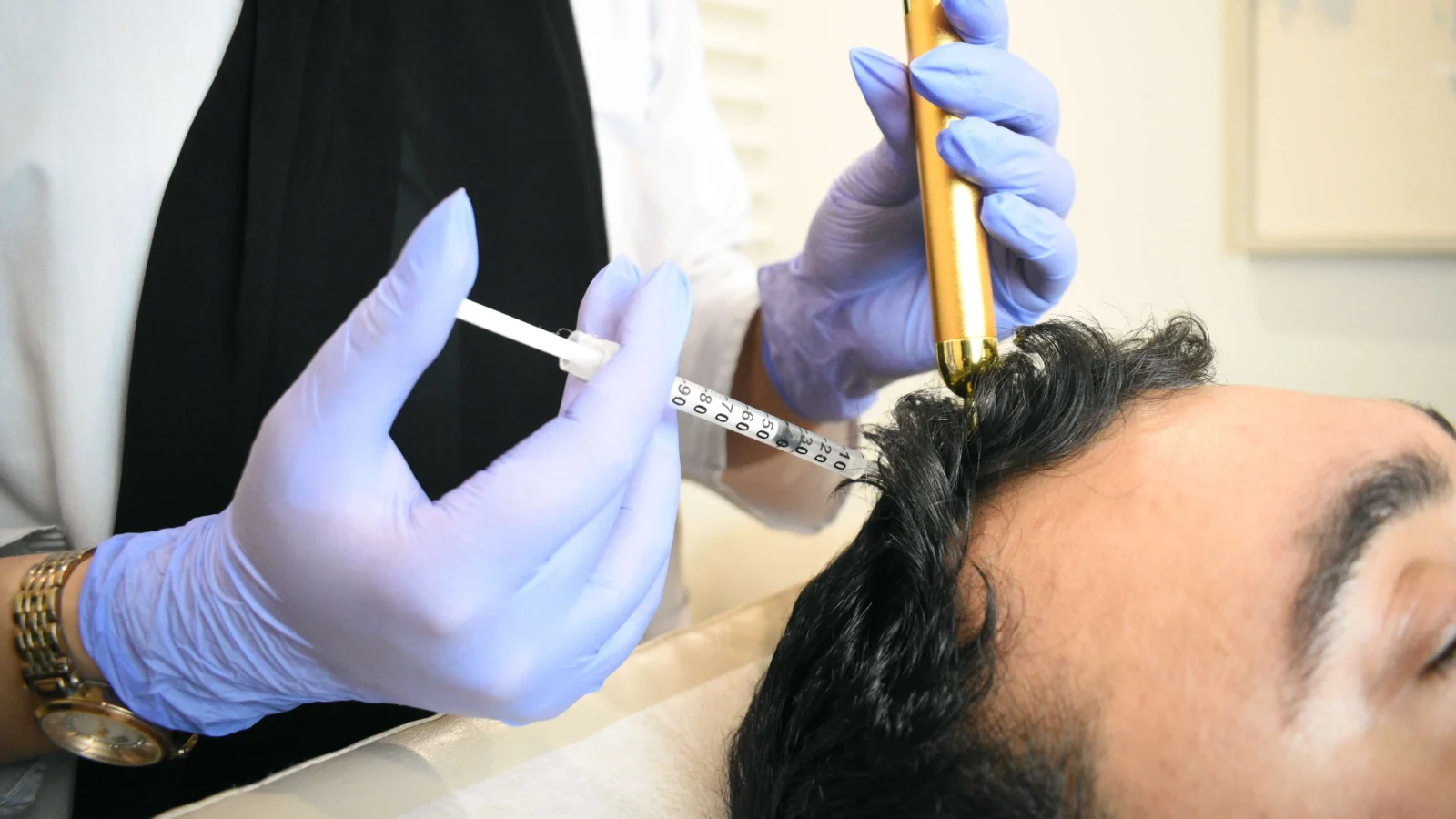
PRP hair treatment uses a concentrated preparation of your own platelets, separated from a small blood sample, to deliver growth factors directly into the scalp. Platelets are best known for clotting blood, but they also carry proteins that signal tissue repair and cell growth. Injected into thinning areas of the scalp, these growth factors are thought to prolong the active growth phase of the hair cycle and improve blood supply to the follicle.
It’s most commonly used for androgenetic alopecia (male and female pattern hair loss), the most frequent cause of thinning hair, though it’s also used alongside other treatments for postpartum shedding and stress-related hair loss.
Does PRP actually work? What the studies show
This is the part most PRP articles skip or overstate. Recent meta-analyses give a more precise picture.
A 2025 systematic review and meta-analysis covering 43 randomized controlled trials and over 1,800 participants found that activated PRP significantly increased hair density and reduced recurrence of hair loss compared with placebo. Non-activated PRP, by contrast, carried a higher rate of side effects, so the specific preparation method matters. A separate meta-analysis of androgenetic alopecia trials found average hair density increased from roughly 142 to 178 hairs per cm² following PRP treatment, a statistically significant improvement. Research specifically on female pattern hair loss has reached similar conclusions, though results were noted to vary by treatment protocol and individual factors.
The honest summary: PRP has moderate-to-strong clinical evidence behind it for improving hair density in androgenetic alopecia, particularly when properly prepared and activated. It’s not effective on follicles that are already dormant or scarred, which is why early intervention matters more than waiting until hair loss is advanced.
Why “activation” matters more than most articles mention
One detail the research is specific about: how the PRP is prepared changes the outcome. Activated PRP, where growth-factor release is deliberately triggered before injection, showed significantly better results and fewer side effects than non-activated PRP in the 2025 meta-analysis referenced above. It’s a good question to ask any clinic before booking, since not all PRP protocols are equivalent, and the preparation method is often the difference between a treatment that works and one that doesn’t.
(For the full step-by-step procedure, blood draw, centrifugation, injection technique, see the PRP Hair Treatment service page.)
Who is a good candidate, according to the evidence?
PRP tends to work best for:
- Early to moderate androgenetic alopecia (male or female pattern hair loss)
- Postpartum or stress-related shedding (telogen effluvium)
- Thinning where hair follicles are still active, not areas of long-standing baldness
It’s less effective on scarred or completely dormant follicles. A proper scalp assessment before starting is what determines whether PRP is the right fit, or whether it should be combined with something like microneedling or medical therapy.
What affects results, beyond the treatment itself
The research is consistent on this point: outcomes vary with dosage, injection protocol, and individual factors including underlying conditions like thyroid disorders or PCOS. A healthy diet, adequate sleep, and managing an underlying hormonal cause alongside PRP all support better outcomes.
PRP hair treatment at Bioflex Aesthetics
At our clinics in Islamabad, Rawalpindi, Karachi, and Peshawar, PRP hair treatment starts with a scalp assessment to check follicle activity and identify whether hair loss is androgenetic, stress-related, or linked to an underlying condition worth addressing alongside treatment. That matters more than generic protocols. A patient with early crown thinning and a patient with years of untreated hairline recession aren’t the same candidate, even if both are asking for “PRP.”
Book a free consultation or see our PRP Hair Treatment service page for pricing and package details at your nearest clinic.
Is PRP hair treatment backed by real research, or is it mostly marketing?
It has genuine clinical evidence. Multiple 2024 to 2026 meta-analyses covering thousands of patients found statistically significant improvements in hair density with PRP versus placebo. That said, the research also shows real limits: it works best on active follicles, and results vary by preparation method and individual factors, so it isn’t a universal fix.
Will PRP stop hair loss completely?
No. It improves density and slows shedding in follicles that are still active, but it doesn’t address the underlying cause of hair loss (genetics, hormones, etc.) on its own, which is why an accurate diagnosis before starting matters more than the treatment choice itself.
Does PRP work as well for women as for men?
Research specifically on female pattern hair loss has found PRP effective for density and thickness, though the same studies note results vary by protocol and individual hormonal factors. Worth discussing at consultation rather than assuming a one-size result.
Is PRP a substitute for minoxidil or finasteride, or does it work alongside them?
The evidence points to PRP working best in combination with, not instead of, other treatments. Several studies show better outcomes when PRP is paired with microneedling or topical minoxidil than with PRP alone.
At what stage of hair loss does PRP stop being effective?
Once a follicle is fully dormant or scarred over, common in long-standing, advanced hair loss, PRP has little to work with. That’s the main reason early evaluation matters more than waiting to “see how bad it gets” before seeking treatment.
Sources
- Chen et al., “Platelet-Rich Plasma in the Management of Alopecia: A Systematic Review and Meta-Analysis,” Dermatology and Therapy, 2025. link.springer.com
- “Effectiveness of Platelet-Rich Plasma Therapy in Androgenic Alopecia: A Meta-Analysis,” PMC. ncbi.nlm.nih.gov
- “Effectiveness of platelet-rich plasma in treating female hair loss: A systematic review and meta-analysis of randomized controlled trials,” PubMed. pubmed.ncbi.nlm.nih.gov
This article is for general information and doesn’t replace a medical consultation. Book a free consultation to discuss whether PRP is right for you.
Written by: BioFlex Aesthetics Editorial Team
Reviewed by: Dr. Hifza
Credentials: MBBS, Dermatologist/Aesthetic Physician
PMDC Registration: 25710
Last Medically Reviewed: August 2026
Last Updated: August 2026
