
Written by: BioFlex Aesthetics Editorial Team
Reviewed by: Dr. Maria Ahmed
Credentials: MBBS, Dermatologist/Aesthetic Physician
PMDC Registration: 625405
Last Medically Reviewed: August 2026
Last Updated: August 2026
Search “best acne scar treatment” and you’ll get a dozen different answers, because there isn’t one single winner. What works for a shallow rolling scar can do almost nothing for a deep icepick scar, and a treatment that’s great on fair skin can cause problems on darker skin if the settings aren’t adjusted. The honest answer to “what’s the best treatment” is: it depends on your scar type, your skin, and how much downtime you can afford.
This guide walks through the main options dermatologists actually use, what each one is good at, and how to think about combining them, so you can go into a consultation already knowing roughly what you’re dealing with.
Start with your scar type, not the treatment
Acne scars fall into a few categories, and the category matters more than anything else when picking a treatment.
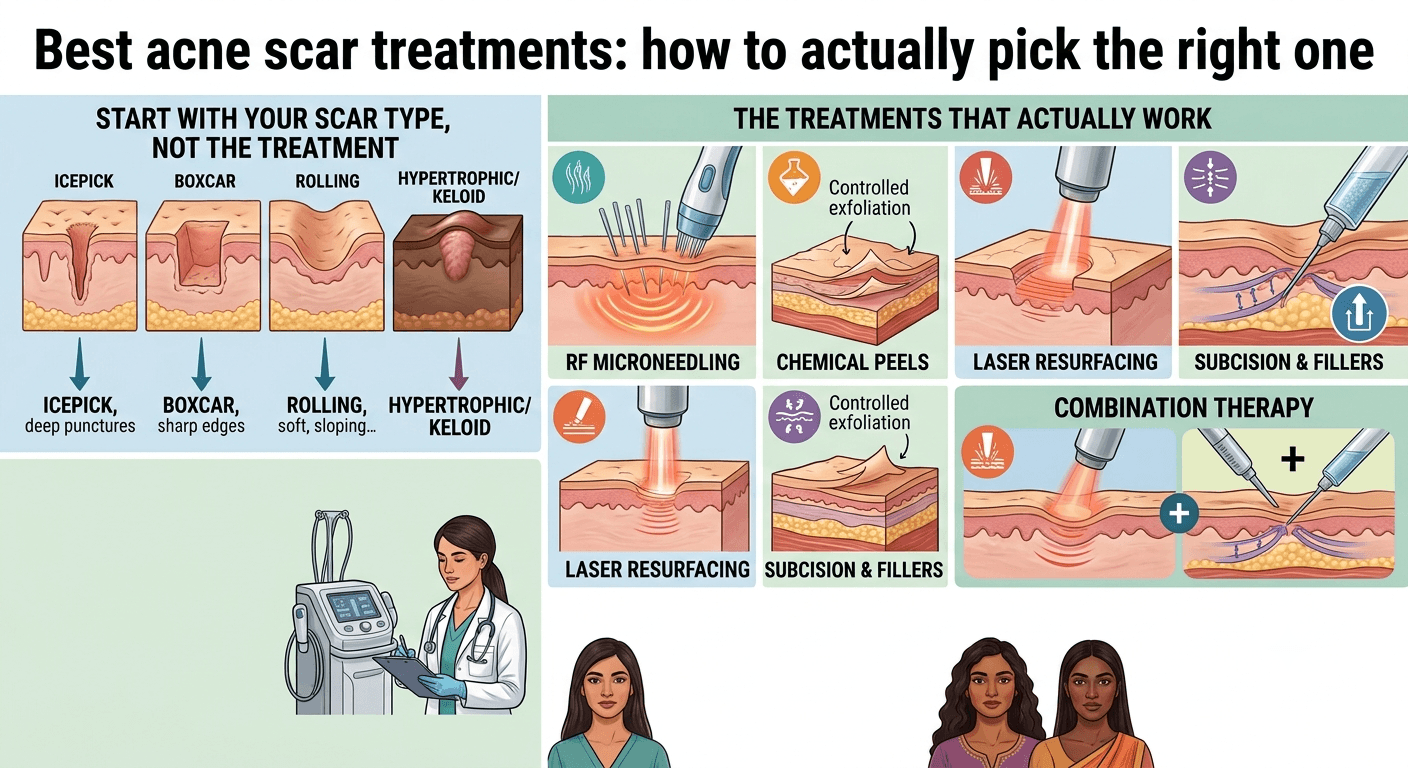
Icepick scars are narrow, deep, and go straight down into the skin, like a small puncture. Boxcar scars are wider with sharper edges, giving the skin a pitted look. Rolling scars have soft, sloping edges that make the skin look uneven rather than pitted. Then there’s hypertrophic and keloid scarring, which is raised tissue rather than a depression, and it’s more common in melanin-rich skin.
A treatment tuned for rolling scars won’t necessarily touch an icepick scar, and vice versa. A remedy that works well on rolling scars might do very little for deep icepick scars, which is why an accurate diagnosis before treatment matters more than picking whatever’s trending.
The treatments that actually work
RF microneedling
Radiofrequency microneedling combines fine needles with heat delivered under the skin, which triggers collagen remodeling without relying on surface-level heat the way lasers do. It’s one of the more versatile options for rolling and boxcar scars, works across a wide range of skin tones when dosed correctly, and needs less downtime than ablative lasers.
Chemical peels
Peels use controlled exfoliation to resurface the top layers of skin, which helps with shallow scarring, uneven texture, and pigmentation left over from old breakouts. Medium-depth peels tend to do more for scarring than light peels, but they need to be matched to your skin tone. A peel strength that’s fine on fair skin can overdo it on darker skin.
PRP (platelet-rich plasma) therapy
PRP uses growth factors from your own blood to speed up healing and boost collagen production. On its own it’s a gentler option, and it’s commonly paired with microneedling, since microneedling combined with PRP can noticeably boost collagen production beyond what either treatment does alone.
Laser resurfacing
Lasers use focused light to remove damaged surface skin and stimulate new collagen, and laser treatments work by removing damaged skin layers and stimulating collagen production, which smooths indented scars and fades discoloration. Fractional and non-ablative lasers are gentler and better suited to darker skin than fully ablative devices, which carry a higher pigmentation risk if not calibrated properly.
Subcision and fillers
For deep rolling or boxcar scars caused by fibrous bands pulling the skin down, subcision releases those bands with a needle, often paired with filler to lift the area immediately. It’s one of the more effective options for scars that other treatments barely move, though it can cause a few days of bruising or swelling.
Combination therapy
Most dermatologists don’t rely on one treatment alone. Subcision combined with fillers can deliver immediate improvement along with ongoing collagen stimulation, and pairing something like laser resurfacing with a chemical peel can address texture and pigmentation in the same treatment plan. If you have more than one scar type, which is common, a combination approach usually gets you further than any single procedure.
What about at-home products?
Retinoids, vitamin C, and niacinamide can help fade discoloration and support collagen production over time, and they’re worth using as maintenance. But for scars that have already changed the skin’s texture, at-home products have limits. In-office treatments performed by a dermatologist tend to be the most effective option for actual scarring, not just surface discoloration, since creams and serums can’t reach the depth where the damage sits.
How long results take
Acne scar treatment isn’t a one-visit fix. Most patients need several sessions spaced weeks apart, and visible improvement tends to build gradually rather than all at once. Deeper scars and darker skin tones both tend to need more sessions, spaced further apart, to get a safe result without triggering pigmentation.
Choosing the right treatment in Pakistan
Skin tone plays a bigger role in treatment selection here than a lot of international guides account for. Most patients across Islamabad, Karachi, Peshawar, and Rawalpindi have Fitzpatrick III to VI skin, which means aggressive settings borrowed from fair-skin protocols carry a real risk of hyperpigmentation. The safest path is a provider who adjusts energy, depth, and peel strength specifically for South Asian skin, rather than applying a generic international protocol.
What BioFlex offers
BioFlex Aesthetics builds acne scar treatment plans around your specific scar type and skin tone, using RF microneedling, chemical peels, PRP therapy, and HydraFacial as supportive care between core sessions. Every plan starts with a consultation to identify whether you’re dealing with icepick, boxcar, rolling, or hypertrophic scarring, since that decides which treatment, or combination of treatments, actually makes sense for you.
Frequently asked questions
What is the single best acne scar treatment?
There isn’t one. RF microneedling and chemical peels tend to work well for shallow to moderate scarring, while subcision and fillers are usually needed for deep rolling or boxcar scars. Most patients get the best results from a combination, not a single procedure.
Can acne scars be completely removed?
Usually not completely, but they can be significantly reduced. Most dermatologists describe the goal as softening the scar and improving skin texture rather than erasing it entirely.
How many sessions will I need?
It varies by scar type and depth, but most treatment plans involve multiple sessions over a few months rather than a single visit.
Are these treatments safe for darker skin tones?
Yes, when the provider adjusts settings for Fitzpatrick III to VI skin. The risk comes from using protocols designed for lighter skin without adjustment, not from the treatments themselves.
Do at-home products work as well as in-office treatments?
Not for true textural scarring. Topicals like retinoids can help with discoloration and support collagen over time, but in-office treatments reach a depth that creams cannot.
Ready to find the right treatment for your scars?
Book a consultation with BioFlex Aesthetics in Islamabad, Karachi, Peshawar, or Rawalpindi to get a treatment plan matched to your scar type and skin tone.
